


Industry News
Ningbo Konger Machinery has made another breakthrough in the research and development of core technology of injection molding machines, and its self-developed drying-free dehumidification screw technology has won patent certification, and the Genie K-TEC and Chameleon series models have been upgraded and optimized, and energy saving and molding accuracy have been further improved. The full range of models has been implemented in mass production cases in six major industries, continuing to empower green and efficient production in the manufacturing industry
Choosing a Fruit Crate Dedicated Injection Molding Machine: From Part Features to Machine Configuration | Konger
A crate is thin-walled, deep and large in projected area, and has to carry a stacked load. Four part features, the difference a dedicated machine makes, four selection traps and a trial checklist.
Interface Commissioning on Horizontal Injection Molding Machines: Mould, Auxiliary and Automation Coordination | Konger
The last mile of commissioning is rarely on the machine itself. Six interface problems between injection molding machines, moulds, auxiliary equipment and automation, with the order and checklist to commission them.
Ten "False Faults" in Horizontal Injection Molding Machine Commissioning | Konger
Most commissioning time is lost to false faults rather than real ones. Ten common misjudgements on horizontal injection molding machines, the evidence that separates them from genuine faults, and what to do about each.
Commissioning Troubleshooting for Horizontal Injection Molding Machines: Eight Common Issues | Konger
Most commissioning problems are not process problems. A practical path through eight common issues on horizontal injection molding machines: no clamp, weak clamping force, injection unit judder, nozzle leaks, short shot with flash, weight drift, ejection faults and mold-protection false alarms, with Konger K-TEC design and service support.
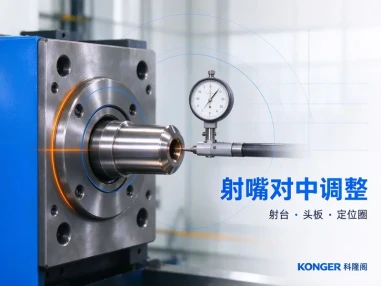
Nozzle Alignment on Horizontal Injection Molding Machines | Konger
An off-centre nozzle leaks at the sprue bush, destabilises the cushion and wears the bush on one side. A step-by-step method: locating-ring datum, dial-indicator and imprint checks, lateral, height and pitch adjustment, re-check after tightening, and hot-state verification.
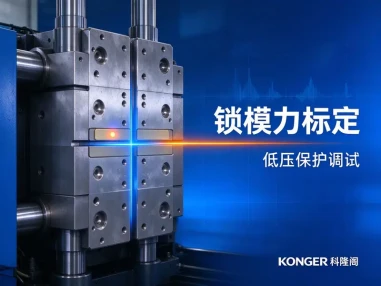
Clamping Force Calibration & Low-Pressure Mold Protection | Konger
Clamping force is not a matter of more is better. A field guide to projected-area and specific-pressure estimation, on-machine force calibration, stepped low-pressure mold protection and template parallelism checks, with Konger K-TEC clamping design.
Horizontal injection molding machine installation and commissioning full process guide: Konger model technical advantages analysis
Complete technical path for horizontal injection molding machine installation and commissioning: from foundation load-bearing, rough and fine leveling, and template parallelism, to hydraulic exhaust, segmented temperature curves, clamping force estimation, and low-pressure protection setting, to short shot method first mold verification. Combining the advantages of Konger K-TEC, CMS series in clamping rigidity, precision temperature control, and specialized configuration, and including common commissioning fault troubleshooting directions, to help on-site shorten machine setup cycles.
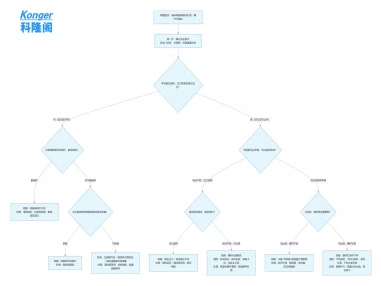
Troubleshooting and Solutions for the Fault: The Material Storage Solenoid Valve Indicator Light of Horizontal Injection Molding Machine Is On, but the Screw Does Not Store Material
In after-sales maintenance of horizontal injection molding machines, a typical fault is frequently encountered: when the material charging (melting) action is triggered, the indicator light of the material charging (plasticizing) solenoid valve lights up normally and the PLC output signal is valid, yet the screw fails to rotate and no charging back-off action occurs. A lit indicator only means the solenoid coil receives an electrical signal; it does not guarantee the hydraulic circuit has shifted properly or built up driving pressure. Following the troubleshooting principle of **from simple to complex, external checks before internal disassembly**, this article sorts out all potential fault causes, judgment methods and corresponding solutions to help on-site technicians and workshop maintenance personnel locate faults quickly and carry out maintenance safely.
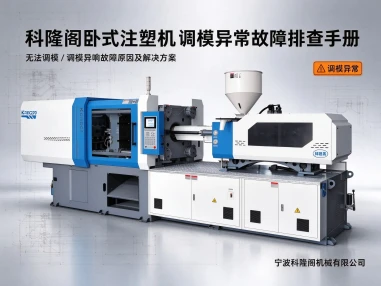
Horizontal Injection Molding Machine Mold-Adjusting Abnormalities (Unable to Adjust Mold / Abnormal Noise During Mold Adjustment) Troubleshooting Manual
For electric mold-adjustment models: power and communication faults, mold-adjusting servo drive alarm, servo motor failure.
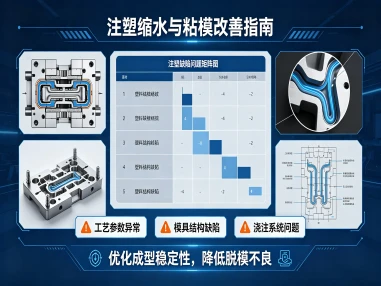
Comprehensive Analysis of the Causes of Injection Mold Sticking Faults and Targeted Solutions
Injection mold sticking (mold sticking to the mold) is a high-frequency quality defect in plastic molding production. Specifically, after the mold opens, the plastic product firmly adheres to the surface of the front mold or rear mold cavity/core and cannot be demolded and removed normally, easily causing product scratches, deformation and scrapping, while also delaying the production rhythm, reducing injection molding production efficiency, and seriously affecting mold service life and mass-production stability. Combining first-line injection molding production practical experience, this article comprehensively sorts out the core causes of mold sticking and related product shrinkage faults, analyzes the problems from multiple dimensions including injection molding process parameters, mold structure design, mold surface condition and gating system, and provides standardized, implementable rectification countermeasures, providing technical reference for injection molding manufacturers to quickly solve sticking problems and optimize molding processes.