


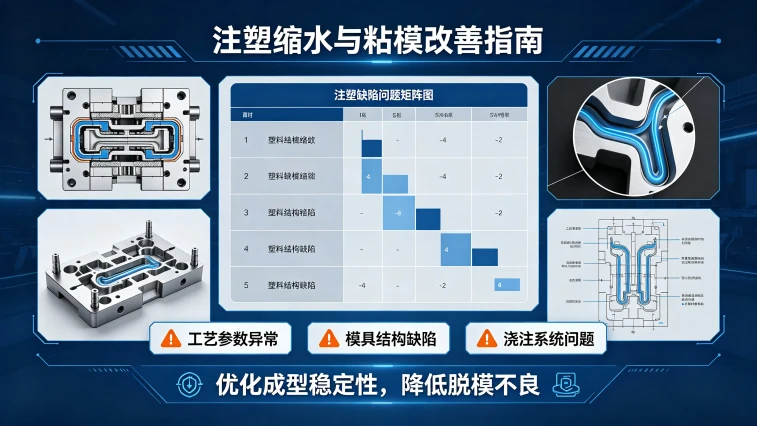
Injection mold sticking (mold sticking to the mold) is a high-frequency quality defect in plastic molding production. Specifically, after the mold opens, the plastic product firmly adheres to the surface of the front mold or rear mold cavity/core and cannot be demolded and removed normally, easily causing product scratches, deformation and scrapping, while also delaying the production rhythm, reducing injection molding production efficiency, and seriously affecting mold service life and mass-production stability. Combining first-line injection molding production practical experience, this article comprehensively sorts out the core causes of mold sticking and related product shrinkage faults, analyzes the problems from multiple dimensions including injection molding process parameters, mold structure design, mold surface condition and gating system, and provides standardized, implementable rectification countermeasures, providing technical reference for injection molding manufacturers to quickly solve sticking problems and optimize molding processes.
I. Overview of Injection Mold Sticking Faults
In the plastic injection molding process, mold sticking is a high-frequency molding defect second only to shrinkage. In many production scenarios, the product first develops a shrinkage problem, and operators blindly adjust process parameters, which then triggers serious sticking and mold-sticking faults, forming a dual production problem.
The characteristics of conventional mold sticking faults are very clear: after the mold completes its opening/closing actions, the molded product cannot be smoothly demolded with the ejection system and adheres unilaterally to the surface of the front mold or moving rear mold. Forced demolding causes the product to whiten, crack and be short of material, while also scratching the mold cavity and runner surface, causing secondary mold damage and increasing repair costs and shutdown losses. To completely cure the sticking problem, one must abandon single-parameter adjustment thinking and conduct all-round investigation and rectification from the process, mold and molding environment.
II. Core Cause Analysis of Mold Sticking and Shrinkage Faults
Combining summaries of large-batch injection production cases, sticking and shrinkage faults are not caused by a single factor. They are mainly divided into four major categories: abnormal injection molding process parameters, mold structure and precision defects, unreasonable gating system design, and poor mold surface condition. The specific causes of each type are as follows:
(I) Improper Injection Molding Process Parameter Settings (the most important cause)
Most sticking problems originate from insufficient matching of molding parameters. Parameter overload, temperature abnormality and cycle imbalance are the core causes, and they also trigger product shrinkage defects:
Excessive injection pressure and shot volume: excessively high injection pressure and excessive shot volume cause over-filling of the mold cavity. The molten plastic fits tightly against the mold inner wall under high pressure, greatly increasing the shrinkage grip force between the product and the mold, making it difficult to demold after mold opening and directly triggering sticking; at the same time, local over-filling and uneven force cause shrinkage indentations on the molded product.
Abnormal injection time and barrel temperature: excessively long injection holding time and excessively high barrel temperature make the plastic melt too fluid and the holding pressure overloaded. After the product cools and sets, the internal stress is too large and it tightly adsorbs onto the mold cavity; while a too-short molding cycle and insufficient cooling time cause the product surface layer to not fully solidify, and soft plastic easily adheres to the mold surface.
Imbalanced mold temperature: both too high and too low mold temperatures can cause sticking faults. If the mold temperature is too high, the product cools slowly and the surface is sticky, making it easy to stick during demolding; if too low, the plastic melt fills unevenly, local under-filling causes shrinkage, and local tight filling adheres to the mold, causing demolding jamming and sticking.
Uneven material feeding: unreasonable gate layout and size cause unbalanced cavity filling, with some areas over-filled and some under-filled, simultaneously triggering both sticking and shrinkage defects.
(II) Mold Precision and Structure Defects
The mold's own structural design and assembly precision problems are the stubborn causes of sticking faults and are also key points easily overlooked in daily production:
Core misalignment and offset: long-term mold opening/closing vibration and assembly errors cause misalignment of the core and cavity. After molding, the fit clearance with the mold is abnormal, local areas clamp tightly onto the mold, and the product cannot fall off normally after mold opening.
Missing demolding structure design: the mold cavity and core are not designed with reasonable demolding chamfers, or the demolding draft angle is insufficient, causing excessive contact area between the product and the mold inner wall after molding, sharply increased friction, excessive ejection resistance and sticking.
Poor mold surface condition: rough cavity and core surfaces with scratches, burrs and uneven flaws cause the molten plastic to embed into the fine texture of the mold, firmly jamming after cooling and setting, causing difficult demolding and sticking scratches.
(III) Gating System Design and Assembly Problems
As the plastic feed channels, the design, machining and assembly precision of the runner and gate directly affect molding stability and are important causes of sticking faults:
Insufficient runner cooling effect: unreasonable runner cooling circuit design or insufficient cooling time causes the runner sprue to not fully solidify, adhering to the runner inner wall and dragging the whole product into sticking.
Unreasonable runner structure parameters: insufficient runner demolding angle and oversized runner bore cause excessive friction between the sprue and the runner so it cannot separate smoothly; an unsmooth runner inner surface with chamfers and outer hole damage aggravates sprue jamming and adhesion.
Nozzle and runner fit deviation: misalignment or abnormal fit clearance between the runner concave arc and the injection molding machine nozzle causes overflow and material accumulation during feeding, which seizes the runner after solidifying and triggers sticking.
No runner retention (undercut puller) structure: the mold is not designed with a runner retention or cold-slug well puller structure, so the sprue cannot be fixed during mold opening and shifts with the product, causing uneven force and product sticking to the mold.
III. Targeted Solutions for Mold Sticking and Shrinkage Faults
For the various fault causes above, combined with standardized injection molding production processes and mold maintenance specifications, a set of rapidly implementable rectification solutions that treat both symptoms and root causes has been compiled, which can be precisely matched and handled according to the on-site fault phenomenon:
(I) Optimize Injection Molding Process Parameters to Cure Parameter-Type Faults
For sticking and shrinkage problems caused by abnormal process parameters, prioritize fine-tuning and optimizing the parameters. No mold modification is needed and results are quick:
Reduce the injection pressure, reduce the shot volume and shorten the injection holding time to avoid over-filling of the cavity, reduce the shrinkage grip force of the product on the mold, and at the same time improve the product shrinkage problem;
Appropriately lower the barrel temperature to reduce the viscosity of the plastic melt and its adsorption force on the mold, avoiding high-temperature melt adhering to the cavity;
Extend the molding cycle and cooling time to ensure the product and runner sprue are fully cooled and set, eliminating soft-material sticking and demolding deformation;
Precisely adjust the mold temperature, matching a reasonable mold temperature according to the characteristics of the plastic material, avoiding sticking from too-high mold temperature and shrinkage from uneven filling with too-low mold temperature;
Adjust the injection speed to feed at a uniform rate, improving the problems of uneven cavity filling and local over-filling and balancing molding quality.
(II) Mold Repair and Rectification to Fix Structure and Precision Defects
For stubborn sticking caused by mold structure, precision and surface flaws, regular mold inspection and maintenance should be carried out:
Repair the mold cavity and core, grind and polish rough surfaces, and repair scratches and burrs to ensure smooth mold inner walls and reduce demolding friction;
Correct the mold demolding chamfers, increase the demolding draft angle, optimize the demolding structure, reduce product ejection resistance and ensure smooth demolding;
Calibrate the core position, repair core misalignment and offset problems, ensure the front/rear mold clamping precision, and eliminate the hazard of product sticking in the mold;
Optimize the gate structure, change the gate size and adjust the gate position to improve feed uniformity and solve abnormal local filling.
(III) Optimize the Gating System to Solve Runner-Type Sticking Problems
For sticking and sprue jamming caused by abnormal runner and nozzle fit, carry out targeted rectification of the gating system:
Repair the runner structure, grind and polish the runner inner wall, repair outer hole damage, optimize the runner arc and demolding angle to ensure smooth sprue demolding;
Re-calibrate the fit position between the injection molding machine nozzle and the runner concave arc to ensure concentricity and tight fit, eliminating material accumulation, overflow and jamming;
Optimize the runner cooling circuit and extend the runner cooling time to ensure the sprue fully solidifies;
Install a runner retention and cold-slug puller structure on the mold to fix the sprue position, stably pulling out the sprue during mold opening and preventing product offset and sticking.
IV. Summary and Prevention Suggestions
Injection mold sticking and product shrinkage are two molding defects that complement each other. Imbalanced process parameters are the main cause, and mold structure and gating system defects are the stubborn hazards. In daily injection production, to reduce the fault incidence, one must adhere to the principle of “adjust the process first, repair the mold second, and maintain regularly”.
In daily production, core parameters such as injection pressure, shot volume, temperature and cooling cycle should be set in a standardized way according to the characteristics of the plastic raw material and the product structure and dimensions, avoiding blind parameter changes; the mold should be inspected and maintained regularly, with the cavity and runner polished, mold precision calibrated and demolding structure optimized; at the same time, gating system maintenance should be carried out to ensure precise fit between the nozzle and runner, fundamentally eliminating sticking and shrinkage faults and improving the yield and production efficiency of injection products.