


In-Depth Analysis of Injection Molded Product Shrinkage Defects | Cause Tracing and Systematic Solutions_Injection Molding Process Optimization
In large-scale injection molding production, product shrinkage and local surface indentations are the most common injection molding quality defects in the industry, frequently occurring in areas with large wall thickness differences such as bosses, reinforcing ribs and thick material accumulation. This defect not only destroys the consistency of product appearance, but in severe cases causes dimensional oversize, insufficient structural strength, assembly failure and other problems, directly affecting the finished product yield and batch delivery stability. It is also a key process challenge that many injection molding processing plants focus on overcoming. Ningbo Konger Machinery has long been deeply engaged in the R&D of high-end injection molding equipment and the optimization of precision injection molding processes. Relying on a large number of on-site commissioning cases and equipment technical accumulation, it has completed multi-dimensional root-cause analysis of injection shrinkage defects, forming standardized solutions covering process, equipment, mold and raw materials, helping injection molding enterprises precisely solve shrinkage defects and stabilize mass production quality.
I. Core Principle of Shrinkage Defects
The core cause of injection shrinkage is the molding defect caused by insufficient volumetric shrinkage compensation when the plastic melt cools and solidifies. Plastic has inherent volumetric shrinkage when transitioning from a molten to a solid state. If the melt refill during molding is not timely and the cooling rates of different areas are uneven, the melt in the mold surface layer solidifies first, and the voids generated by the internal thick material areas cannot be filled by the melt, finally forming indentations and depressions on the product surface. Compared with ordinary appearance defects, injection shrinkage defects have complex causes, usually resulting from the superposition of multiple dimensions of injection molding process parameters, equipment operating conditions, mold structure and raw material characteristics, rather than being caused by a single problem. This is also the core reason why shrinkage problems recur.
II. Comprehensive Cause Tracing of Shrinkage Defects
Combining Konger Machinery's massive on-site commissioning and mass-production implementation cases, we systematically divide the causes of injection product shrinkage defects into four major dimensions: molding process, equipment operating conditions, mold structure and raw material characteristics, precisely sorting out the root causes of various defects and providing the core basis for targeted rectification and rapid solution of injection shrinkage problems:
1. Unreasonable Molding Process Parameters (Core Cause)
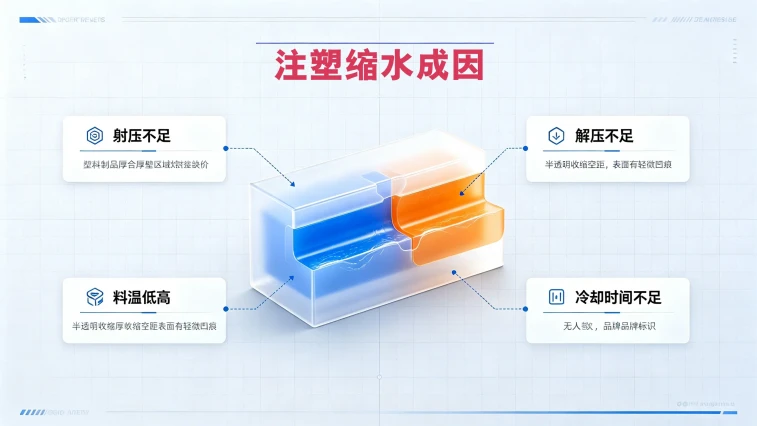
Improper matching of molding process parameters is the core cause of injection shrinkage defects, directly determining melt filling, plasticizing uniformity and compensation effect, and is also the core entry point for on-site machine adjustment to improve shrinkage. Common parameter abnormalities include: injection pressure and injection speed too low, resulting in insufficient melt filling power and incomplete cavity filling; injection time insufficient, with insufficient feed volume into thick-wall areas and incomplete material filling; melt back pressure too low, with poor raw material plasticizing uniformity and uneven internal stress and shrinkage of the melt; insufficient holding pressure and short holding time, with the gate freezing and sealing early and no melt to compensate the shrinkage voids later; barrel temperature too high, increasing the overall melt shrinkage rate and aggravating post-molding shrinkage; insufficient cooling time, with the product demolded before fully cured and set, causing secondary shrinkage indentations from natural cooling later.
2. Abnormal Injection Molding Equipment Operating Conditions (Hidden Cause)
Equipment wear, part aging and mechanism abnormalities are hidden disease factors that continuously destroy injection molding stability and trigger batch injection product shrinkage defects. Main equipment problems include: nozzle orifice diameter too small or internal foreign matter accumulation, causing large feed resistance and insufficient feed volume; injection assembly parts worn out after long operation, with declining injection precision and pressure stability, failing filling and compensation precision; screw specification mismatched with product molding needs, with excessive redundant shot volume causing melt pressure imbalance; material port bridging and blockage, and cooling water circuit water ring interruption without circulation, causing discontinuous feeding and unstable temperature control, which in turn leads to uneven melt shrinkage.
3. Mold Structure Design Defects (Root Cause)
Unreasonable mold structure design is the fundamental cause of stubborn injection shrinkage in thick material areas, bosses and reinforcing ribs, and is also the key crux why process adjustment cannot completely solve the shrinkage problem. Typical design defects are as follows: overall mold temperature too high, slow melt cooling speed and increased overall shrinkage; imbalanced gate system design, with gate size too small and poor runner fluidity, causing high melt conveying resistance; unreasonable gate layout, opening gates in thin-wall areas of the product so that thick material accumulation areas cannot obtain effective pressure supply; gate length too long, with severe pressure transmission loss and greatly attenuated compensation efficiency; product bosses and reinforcing rib walls too thick, with large material accumulation and significant cold-hot shrinkage differences, and no targeted material-reduction optimization structure.
4. Raw Material Characteristic Problems
Some crystalline plastic raw materials inherently have high molding shrinkage rates, and conventional standard injection molding processes cannot offset their inherent shrinkage characteristics. If no modification and adaptation are carried out according to the raw material characteristics, injection surface shrinkage defects are easily continuously produced after molding, which is a long-standing quality hazard in injection production.
III. Systematic and Implementable Improvement Solutions
For the above multi-dimensional causes, Konger Machinery, relying on its equipment R&D capability and front-line injection molding process commissioning experience, has established a standardized rectification system that goes from shallow to deep, process first then equipment, and commissioning first then mold modification, creating a professional injection shrinkage solution that balances rectification efficiency, production stability and mass-production implementability:
1. Process Parameter Optimization (Priority Commissioning, Fast Results)
Process parameter optimization is the low-cost, high-efficiency priority rectification solution for injection shrinkage problems, quickly improving most conventional shrinkage defects and adapting to the mass-production scenarios of the vast majority of injection products. By precisely matching molding parameters: appropriately increase the injection pressure and injection speed to improve melt filling power and ensure full cavity filling; reasonably extend the injection time to ensure sufficient feed into thick-wall areas and full material filling; increase the melt back pressure to optimize raw material plasticizing uniformity and weaken local shrinkage differences; correspondingly increase the holding pressure and extend the holding time to continuously complete pressure compensation before the gate freezes, offsetting the volumetric loss of melt solidification; appropriately lower the barrel temperature to suppress excessive melt shrinkage rate; reasonably extend the cooling time to ensure the product is fully cured and set before demolding, avoiding secondary shrinkage indentations in the later stage.
2. Equipment Inspection, Repair and Adaptation Optimization (Stabilizing Production Conditions)
Routine equipment inspection and precision repair can completely eliminate continuous injection shrinkage defects caused by hardware abnormalities, stabilizing injection molding quality from the equipment side. Specific optimization solutions: clean foreign matter inside the nozzle and enlarge overly small orifice diameters to ensure smooth and stable feeding; comprehensively inspect and repair injection assembly components, promptly replace and calibrate worn parts to restore injection precision and pressure stability; match and replace screws of suitable specifications according to product shot weight and molding needs to achieve precise controlled-volume injection; regularly maintain the feeding mechanism and cooling water circuit to solve material port bridging and blockage, ensure normal water ring circulation, and stabilize the equipment molding temperature control system.
3. Mold Structure Optimization (Permanently Solving Stubborn Shrinkage)
For stubborn injection shrinkage defects that process commissioning cannot eliminate, root-cause optimization must be carried out from the mold structure end to completely cure the shrinkage problem. Through systematic mold modification upgrades: reasonably lower the mold temperature to accelerate uniform melt cooling and reduce overall shrinkage; optimize the gate system structure, enlarge the gate flow cross-section and improve runner smoothness to reduce melt conveying resistance; re-plan the gate layout, moving the gate from thin-wall areas to thick material areas such as bosses and reinforcing ribs to achieve nearby pressure and shrinkage compensation; optimize the gate length to reduce pressure transmission loss and improve compensation efficiency; perform material-reduction optimization for overly thick bosses and reinforcing ribs, reducing product wall thickness differences and balancing the cooling and shrinkage rates of each area, eliminating shrinkage hazards from the structure end.
4. Raw Material Modification and Adaptation (Targeted Improvement of Material Shrinkage)
For high-shrinkage crystalline plastics, the material molding characteristics can be optimized through raw material modification. By adding functional filling additives, switching to low-shrinkage special-grade raw materials and other methods, the material molding shrinkage rate can be effectively reduced, suppressing the generation of injection product shrinkage defects from the material source, and adapting to the molding needs of high-precision products.
IV. Konger's Professional Summary
The governance of injection product shrinkage follows the industry logic of three parts process commissioning, four parts equipment precision and three parts mold structure. Adjustment of a single dimension cannot achieve complete cure. The scientific rectification process of “process commissioning first, equipment inspection second, and mold optimization last” must be strictly implemented. Ningbo Konger Machinery focuses on the R&D and manufacturing of high-end injection molding machines and supporting precision injection molding process services. With years of deep experience in the injection molding industry, it has accumulated rich practical experience in mass-production defect rectification, precise equipment adaptation and customized process optimization, and can comprehensively solve all kinds of injection molding defects.
The company not only provides the industry with high-stability, high-precision injection molding equipment, but also is equipped with a complete full-process injection molding process solution, and can provide one-on-one precise commissioning and systematic rectification services for all kinds of common injection molding defects such as shrinkage, sticking, flash, short shot and warpage, helping manufacturing enterprises improve product yield, compress production costs, achieve high-quality stable mass production, and create long-term production value for customers.