


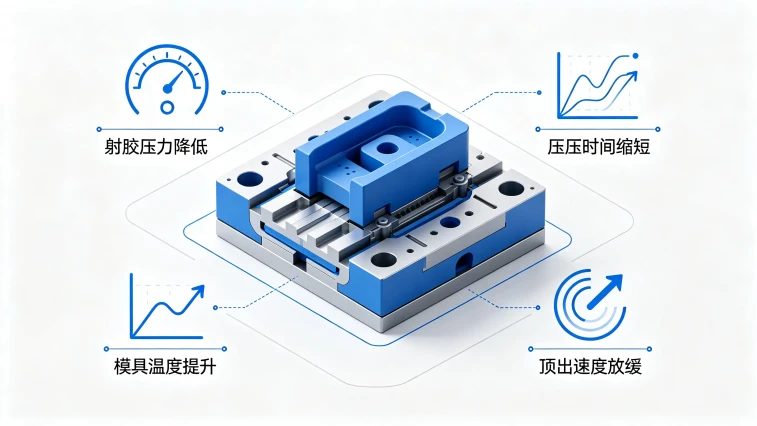
Difficult demolding is one of the high-frequency faults at injection molding sites. After mold opening, the product is stuck on the core or cavity and cannot be smoothly ejected, which easily causes part scratches, ejector white marks, cracking and deformation, and in severe cases, ejector pin breakage and mold damage, directly reducing production yield and lengthening the molding cycle, bringing shutdown losses and rising production costs to the enterprise.
The essence of difficult demolding is that the shrinkage grip force and frictional resistance generated by the plastic part on the mold after cooling shrinkage are greater than the effective ejection force the equipment ejection system can provide. The fault sources span injection molding process, equipment condition, mold design and machining, and product residual stress in four major dimensions, and must be checked level by level following the logic of “process and equipment first, mold modification later” to avoid unnecessary investment from blind mold modification. Konger K-TEC servo energy-saving series and CMS two-color and multi-color series machines feature multi-stage ejection and precise pressure and speed adjustment functions, which can work with process optimization to improve demolding conditions and provide hardware support for stable mass production.
I. Main Fault Cause Analysis and Corresponding Improvement Countermeasures
1. Over-Filling (Excessive Fill)
Phenomenon: injection pressure and holding pressure are too high, the product is excessively compacted, shrinkage becomes smaller, the shrinkage grip force on the core increases significantly, and the product tightly grips the core and is hard to release.
Solution: reduce the injection pressure, optimize the injection speed, reasonably control the injection time, and lower the holding pressure and holding time to avoid over-filling. Prioritize adjusting process parameters on the equipment side without directly modifying the mold.
2. Insufficient Ejector Pin Force or Inadequate Ejection Stroke
Phenomenon: the equipment's ejection pressure and speed are set too low, or the ejection stroke is insufficient, so the ejector pins cannot completely separate the product from the core; there may also be wear in the ejection oil circuit or mechanical mechanism causing actual ejection force decay.
Solution: increase the ejection pressure and ejection speed on the injection molding machine, verify the ejection stroke parameters; check the ejection mechanical structure and oil circuit, and carry out repair and maintenance when necessary to ensure reliable ejection mechanism action.
3. Low Mold Temperature
Phenomenon: mold temperature too low causes the plastic to cool too quickly, uneven product shrinkage, excessive local grip force in some areas, and increased demolding frictional resistance.
Solution: appropriately raise the mold temperature, control a reasonable cooling rate, improve the plastic shrinkage state, and reduce mold grip resistance; rely on the injection molding machine's temperature control system to stabilize mold temperature and reduce demolding abnormalities caused by fluctuation.
4. Insufficient Demolding Draft Angle
Phenomenon: the side-wall draft angle of the product is designed too small, causing huge friction between the product and the mold wall during mold opening and ejection, with scratches and sticking, especially prominent in deep-cavity housing products.
Solution: modify the mold to increase the demolding draft angle at the corresponding position; reserve a reasonable draft angle at the product design stage to avoid the risk from the source.
5. Undercuts / Chamfer Interference in Demolding
Phenomenon: the product structure has undercuts or unreasonable chamfers that mechanically interfere and block the product from demolding along the mold opening direction, directly causing it to seize and fail to eject.
Solution: modify the mold to handle the undercut structure; for functional undercuts, add angled ejectors, sliders or core-pulling mechanisms to eliminate interference in the demolding direction.
6. Unbalanced Ejection Force
Phenomenon: unreasonable ejector pin layout concentrates the ejection force in local areas, and positions with large grip force lack ejection support, causing local mold sticking, along with risks of ejector white marks and ejector-through damage.
Solution: modify the mold to optimize the ejection system, adjust and add ejector pin positions so that the ejection force is evenly distributed over the rib, boss and housing side-wall areas with large grip force, achieving balanced ejection.
7. Insufficient Cavity Surface Finish
Phenomenon: high surface roughness of the mold insert and high friction coefficient increase the adhesion friction between the plastic and the mold surface, causing high demolding resistance and easily scratching the product appearance surface.
Solution: modify the mold to polish the cavity and core surfaces, keeping the polishing texture direction consistent with the mold opening direction to reduce frictional resistance.
8. Vacuum Negative Pressure Suction During Demolding
Phenomenon: for deep-cavity and large-area housing products, a vacuum negative pressure forms between the product and the core at the moment of mold opening, firmly adsorbing the product onto the core; simply increasing the ejection force can easily damage the product.
Solution: set slow ejector start after mold opening on the equipment side; install an air-blow valve on the mold and introduce compressed air during ejection to break the vacuum negative pressure — this is a very effective means of solving sticking in deep-cavity parts.
9. Effect of Residual Stress in the Finished Product
Phenomenon: unreasonable injection molding process causes large internal residual stress in the product, which continues to grip the core after cooling; even with qualified draft angle and polishing, demolding remains difficult, accompanied by hidden risks of later deformation.
Solution: optimize the overall mold design; at the same time adjust the injection molding process, reduce holding pressure, reasonably control mold temperature, and reduce the grip effect caused by the release of internal residual stress in the product.
II. Recommended On-Site Troubleshooting Sequence
When handling difficult demolding on site, it is recommended to follow the troubleshooting logic of process first, equipment second, mold last to reduce mold modification costs:
Process check: confirm whether over-filling exists, reduce injection pressure, holding pressure and injection speed to eliminate the large grip force caused by excessive filling;
Equipment check: verify ejection pressure, speed and ejection stroke, and confirm that the equipment mechanical parts and oil circuit are fault-free;
Temperature commissioning: appropriately raise the mold temperature and observe the change in demolding state;
Mold hardware check: polish the mold insert, optimize the demolding draft angle, improve the ejector pin layout, add a vacuum-breaking air valve, and handle undercut interference.
Tip: for deep-cavity housing products, vacuum suction is a very common cause; blindly increasing the ejection force can damage the product, so prioritize the combined solution of slow ejection + air-valve vacuum breaking.
III. Conclusion
Difficult demolding is the result of the combined action of process, equipment, mold and product structure. The Konger Machinery technical team has rich on-site molding service experience and, for various molding scenarios such as fruit baskets, paint buckets, two-color products and PET preforms, can provide customers with equipment parameter recommendations, process commissioning guidance and mold matching selection references, helping manufacturing enterprises reduce defect rates and achieve efficient and stable production.