


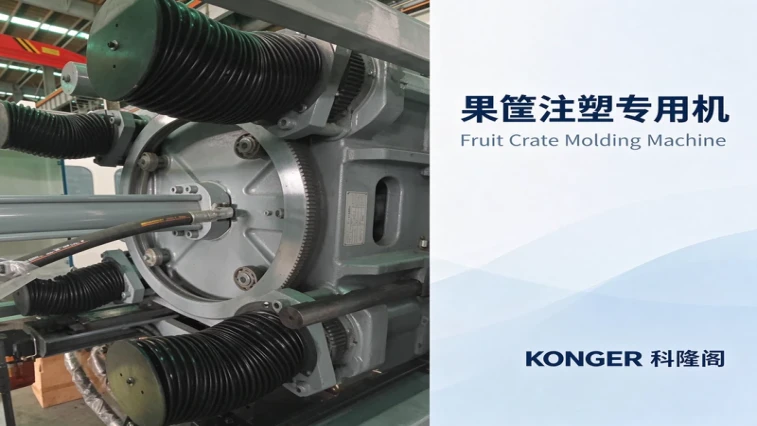
A fruit crate is a thin-walled, deep-cavity part with a large projected area that also has to carry a stacked load. Volumes are large, unit prices are low and lead times are short, so a machine chosen for the wrong reason eats the margin directly. The order of selection should be: look at the part first, derive the parameters second, and verify the structure last — not pick a tonnage first.
1. Four features of the part decide the machine
1.1 Large projected area: clamp force follows the area
A crate opens out into a large area, and the clamp force requirement is set mainly by projected area and cavity pressure. Estimate from the projected area of one cavity multiplied by the number of cavities, then add margin. Choosing a small machine because "the crate is not that big" leads to flash and unstable dimensions.
1.2 Deep cavity and thin wall: shot weight and injection speed
The body is tall and the walls thin, so the melt has a long flow path to reach the bottom and the side walls. Too little shot weight leaves the end of flow short; too little injection speed leaves cold slugs and flow marks. Size the shot against the total shot weight of the mould including runners, with margin, and confirm the injection unit can hold a steady high-speed fill.
1.3 Ribs and stacking load: hold pressure and mould temperature
The ribs in the base and walls determine load capacity. Insufficient hold pressure or uneven mould temperature causes sink at the ribs or weak sections, and the crate deforms when stacked. Zoned mould temperature control and a stable hold-pressure response do more than simply adding clamp force.
1.4 Multi-cavity moulds and high volume: cycle and stability
Crates are usually run on multi-cavity moulds in continuous production, so cycle time and stability set the unit cost. Hydraulic response, the clamp close/open speed profile and ejection repeatability all show up in daily output.
2. How a dedicated machine differs from a general-purpose one
2.1 Platens and tie-bar spacing: the mould has to fit
Crate moulds are large, and on a general-purpose machine they often will not fit, or the clamps cannot reach an effective area. A dedicated machine leaves room in platen size and tie-bar spacing for crate moulds, so mounting and load distribution are sound.
2.2 Shot weight and screw: sized for large PP and PE shots
Crates are mostly PP and PE, with large shot weights and a high regrind ratio. Compression ratio, mixing section and shot capacity have to suit these materials, otherwise plasticising falls short, colour mixes unevenly and the cycle lengthens.
2.3 Opening and ejection stroke: the deep part has to come out
With a deep body, insufficient opening or ejection stroke means the part will not come out, or has to be pulled by hand — hard on the mould and hard on the cycle. Check stroke against mould depth rather than looking at clamp force alone.
2.4 Hydraulics and energy: continuous production
Crate orders are usually long continuous runs, where hydraulic response and energy use are magnified over time. A servo energy-saving hydraulic system that supplies oil on demand suits this duty better than a fixed-displacement pump.
3. Four traps in machine selection
3.1 Tonnage without tie-bar spacing
Enough tonnage but not enough tie-bar spacing, and the mould still will not go in. Mould outline dimensions must be checked against machine data in advance.
3.2 Ignoring ejection stroke and take-out space
Short ejection stroke or no room to take the part out means the robot cannot reach it and someone has to pull it by hand — a cost in both cycle time and safety.
3.3 Ignoring drying and regrind
With a high regrind ratio, moisture and contamination bring silver streaks and lower strength. Drying and feeding have to match the material, and the regrind ratio has to be fixed and recorded.
3.4 Ignoring the auxiliary and automation interfaces
Robot pick position, mould-open signal, conveyor and packing cycle — if these interfaces are not aligned, a stable machine still will not reach volume.
4. How Konger configures a crate machine
Ningbo Konger Machinery Co., Ltd. is based in Ningbo, founded in 2013, and covers the development, manufacture, sales and service of injection molding machines. The range is built around the K-TEC servo energy-saving series, with CMS (Color Mixing System) two-colour and sandwich machines; dedicated configurations are offered for different products across close to thirty customised models, and the fruit crate is one of them.
For crate production, the configuration idea comes down to four points:
Space for the mould. Platen size and tie-bar spacing leave room for the crate mould's outline, avoiding the case where "the tonnage is enough but the mould will not fit".
An injection unit for the material. Screw and shot capacity are set for the large PP and PE shots and the high regrind ratio, so plasticising stays stable and the cycle stays controllable.
Stroke for the deep cavity. Opening and ejection strokes match the crate depth, so the part comes out cleanly and the robot can take it.
Hydraulics and parameters for continuous running. Servo energy-saving hydraulics supply oil on demand, and process and mould parameters can be stored and recalled, so a mould change starts from a known baseline instead of a blank sheet.
5. Trial and acceptance checklist
Do the mould outline, tie-bar spacing and platen size match?
Is there margin on the total shot weight including runners?
Can the opening and ejection stroke take the crate out cleanly?
Do all cavities of a multi-cavity mould fill evenly?
Is there sink at the ribs, and does the crate deform when stacked?
Are drying and regrind ratio fixed to the material?
Do the robot pick position and mould-open signal line up?
After a period of continuous running, are cycle and dimensions stable?
Conclusion
Selecting a crate machine is really translating four part features — projected area, deep thin walls, stacking load, high volume — into four machine parameters: clamp force, shot weight, stroke, and hydraulics with cycle. Get the order right and the machine will not be chosen wrongly. Konger's work on dedicated model configuration and servo energy-saving hydraulics is aimed at exactly this kind of low-margin, high-volume product.