


⚠️ Safety Precaution: Before disassembly of any hydraulic valve, melt motor, barrel or screw, the machine must be shut down, pressure relieved and power disconnected. Wear anti-scald protection when working on the hot barrel. Release residual pressure from hydraulic lines before detaching hoses to prevent high-pressure oil spray injury.
1. Core Failure Logic
Solenoid light ON = Controller sends metering command and the coil is energized. Screw fails to meter. Root causes fall into seven categories: spool seizure / internal leakage, insufficient hydraulic power, melt motor damage, mechanical transmission jamming, feeding & process abnormality, backpressure circuit blockage, and incorrect parameter settings. The primary diagnostic reference is the pressure gauge: whether metering pressure can build up when metering is triggered. This is the key distinction between hydraulic circuit faults and mechanical seizure.
2. Fault Causes & Corresponding Solutions
(1) Metering Solenoid Valve Failure (Power Signal Received, Spool Fails to Shift)
Spool stuck by hydraulic oil contaminants; electromagnetic force cannot shift the spool Symptom: Indicator light is on. Metering works when manually depressing the solenoid override button, but stops once released. Common on machines with dark contaminated oil and overdue filter replacement. Solution: Remove and disassemble the solenoid valve, clean the spool and valve bore, inspect for scoring. Minor scoring can be polished; replace the valve with the same specification if scoring is severe. Replace the hydraulic filter and check oil cleanliness.
Worn spool with severe internal leakage; pressure cannot build up Symptom: Indicator light normal. Pressure remains low and the motor lacks torque even with manual override. Solution: Swap with a known-good solenoid for cross-verification. Replace the valve once internal leakage is confirmed; do not run it under compromised condition.
Blocked pilot orifice on pilot-operated solenoid; insufficient pilot pressure prevents main valve shifting Symptom: Indicator light on, main valve does not shift, main system pressure is normal. Solution: Disassemble and clean the pilot orifice and pilot oil passages to remove sludge. Check whether throttle valves on the pilot circuit are fully closed or clogged.
(2) Hydraulic Power & Circuit Faults (Valve Shifted, No Pressure / Flow to Drive Motor)
Metering pressure or speed parameters set too low Symptom: Low pressure and speed values on the metering page; pressure gauge barely rises during metering. Solution: Refer to the standard process parameters for the machine model and moderately increase metering pressure and speed for testing. Do not set values to maximum at once to avoid shock damage to the melt motor.
Worn main pump with heavy internal leakage; system pressure cannot hold Symptom: Low pressure across all movements, not only metering. Pressure holds at no-load but drops sharply under load. Solution: Test pump pressure profile, repair or replace the main hydraulic pump; inspect oil seals and port plate.
Stuck relief valve or fatigued regulating spring causing pressure relief Symptom: Pressure immediately drains back to tank once metering signal is triggered; pressure cannot build. Solution: Clean the relief valve spool and recalibrate system pressure. Replace the relief valve if the spool is worn or spring fails.
Check valve / shut-off valve stuck closed, blocking oil passage Symptom: Valve shifts normally, but hydraulic oil cannot reach the melt motor inlet. Solution: Follow the hydraulic schematic to inspect check valves and shuttle valves on the metering branch; clean or replace defective valves.
(3) Melt Hydraulic Motor & Transmission Faults (Pressurized Oil Reaches Motor, Motor Does Not Rotate)
Worn port plate or plungers inside melt motor with severe internal leakage Symptom: Pressure gauge shows pressure during metering, but motor only shudders or stalls under load despite free rotation at no load. Solution: Disassemble and service the melt motor, replace seals and port plate. Replace the motor if wear exceeds service limit.
Seized motor bearing or foreign object jamming rotor Symptom: Pressure is normal, motor fully locked, housing heats up rapidly. Solution: Disassemble the motor, remove foreign debris and replace bearings. Replace the motor if housing is scored beyond repair.
Sheared / slipping drive shaft, flat key or coupling between motor and screw Symptom: Motor spins normally while the screw stays stationary; audible free-spinning sound from motor. Solution: Remove the guard between melt motor and injection carriage, inspect drive shaft, flat keys and splines. Replace damaged keys or shaft and re-align coaxiality.
(4) Mechanical Seizure of Screw & Barrel (Motor Delivers Torque, Screw Locked by Material)
Insufficient barrel temperature; un-melted solid plastic locks the screw Symptom: Low zone temperature especially in feed and compression sections. Pressure spikes and overload alarm triggers if metering is forced. Solution: Heat up according to material specification and allow sufficient soaking time. Never force metering under low temperature to avoid shearing screw keys or damaging the melt motor.
Carbonized deposits, hard contaminants or metal debris jamming the barrel Symptom: Long high-temperature idle soak, improper purging or metal chips from regrind material. Screw still stuck after reaching set temperature. Solution: Cool down the barrel, remove nozzle and flange, extract the screw and clean carbon and debris. Inspect screw and barrel surface for scoring; polish or replace screw and barrel assembly if damaged.
Stuck check ring assembly; melt components locked together Symptom: Screw cannot rotate and pressure keeps climbing. Solution: Pull out the screw, disassemble and clean check ring and thrust ring, check clearance. Replace the complete check ring assembly if heavily worn.
(5) Backpressure Circuit Faults (Excessive Backpressure Prevents Screw Retraction)
Over-high backpressure setting holding the screw back Symptom: Motor tends to rotate on metering signal but screw cannot retract with high pressure reading. Solution: Slowly reduce backpressure and retest metering; readjust backpressure to proper process value after normal production resumes.
Backpressure valve spool stuck closed; backpressure cannot be relieved Symptom: Adjusting the backpressure knob produces no change; system stays locked at high backpressure. Solution: Remove and clean the backpressure valve spool; replace the valve if spool is worn.
(6) Feeding & Process Related Faults (Screw Rotates but Fails to Meter, Often Misjudged)
Note: The screw rotates in this case, yet does not retract for metering, which is frequently mistaken as a metering failure.
Bridging in hopper, material shortage or clumped regrind Symptom: Screw spins freely with no material feeding; metering position remains unchanged. Solution: Clear clumps in hopper, add vibrator or agitator if needed, replenish raw material and control regrind ratio.
Failed cooling water jacket at feed throat; premature melting and material sticking Symptom: Plastic melts too early at feed zone, wraps the screw and causes feed slippage. Solution: Flush cooling circuit and ensure adequate water flow, clear stuck material at feed throat and adjust feed zone temperature.
Over-damp material or lubricant additives (PTFE, high-lubricity additives) causing screw slip Symptom: Screw spins at high speed without conveying melt for metering. Solution: Fully dry raw material, adjust feed zone temperature and cooling flow; replace feed section screw geometry if necessary.
(7) Hidden Limits, Program & Safety Interlock Restrictions (Light On, Action Intercepted)
False trigger of metering limit or injection end limit; controller judges metering completed and cuts output Symptom: Solenoid light turns on briefly then goes out without continuous output. Solution: Inspect metering end and injection end proximity switches, adjust trigger position or replace faulty sensors.
Safety door or safety interlock valve not reset; melt oil circuit mechanically cut off despite valid electric signal Symptom: Controller outputs signal and light is on, yet interlock valve shuts off oil supply to melt motor. Solution: Confirm front & rear safety doors are fully closed, inspect safety interlock valve and clean seized spool.
Wrong metering mode or metering timer setting Symptom: Special mode selected such as “decompress after plasticizing”, or metering time set extremely short. Solution: Refer to machine manual, restore standard metering mode and set reasonable metering time limit.
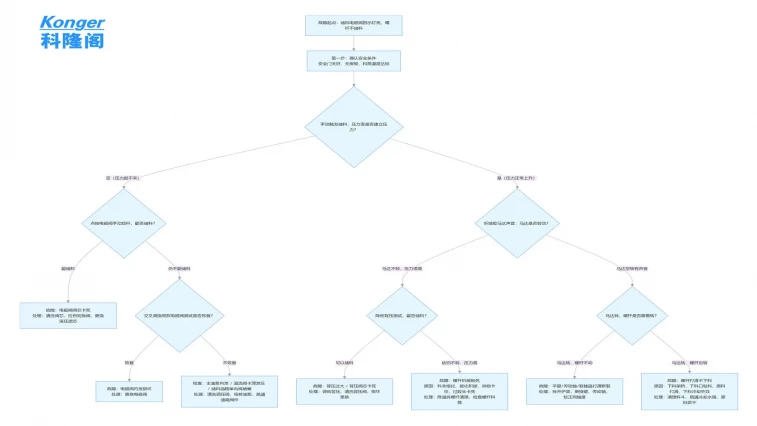
3. Recommended Step-by-Step Field Troubleshooting Sequence by Konger
Safety check: Close safety doors and confirm no active alarms.
Observe pressure gauge while triggering manual metering: ✅ Pressure builds up → Suspect mechanical seizure, transmission failure, feed slip or backpressure lock. ❌ No pressure build-up → Suspect solenoid seizure / internal leakage, pump fault, relief valve or blocked circuit.
Test by manually pressing solenoid override: Works → Solenoid spool seized; Still fails → Check hydraulic circuit, melt motor and screw assembly.
Listen to melt motor: Motor spins, screw stationary → Drive key / shaft slipping; Motor stationary with high pressure → Load seizure; Motor free spins with low pressure → Motor internal leakage.
Verify barrel temperature, feed throat condition and backpressure setting.
Cross-test with spare solenoid to quickly rule out valve defect.
If all above checks pass, perform deep disassembly inspection on screw and melt motor.
4. Routine Maintenance Recommendations
Replace hydraulic oil and filters on schedule to maintain oil cleanliness and reduce spool seizure risk.
Avoid prolonged high-temperature soaking during standby to prevent carbon buildup and screw seizure.
Install magnetic separators for regrind material to block metal debris entering barrel.
Periodically inspect feed cooling jacket, backpressure valve and melt motor seals.
Calibrate system pressure and action pressure parameters after overhaul or machine commissioning.
5. After-sales Support
If the fault persists after following this guide, please contact the technical service team of Ningbo Kongerge Machinery Co., Ltd. (Konger). We provide remote technical guidance, on-site maintenance, hydraulic system retrofitting and customized screw & barrel solutions for horizontal injection molding machines.