


I. Defect Overview
During injection molding production, the outer surfaces corresponding to reinforcing ribs, blind-hole screw bosses and grid rib positions of plastic products are highly prone to local sinking, which the industry collectively calls sink marks (shrinkage indentations). Mild sink marks affect the appearance of products and fail to meet the shipping standards for appearance parts; severe sink marks are accompanied by internal vacuum bubbles, reducing product structural strength and causing batch defects, raw material loss and delivery delays, making them a high-frequency pain point in the production of automotive parts, logistics baskets, daily necessities and home appliance housings.
Core mechanism of sink marks: plastic melt undergoes volumetric shrinkage during the cooling stage. Ribs and blind holes are areas of concentrated wall thickness where cooling lags behind; if continuous melt refill cannot be obtained, the surface layer solidifies while the interior continues to shrink, pulling the surface and forming indentations.
II. Main Cause Analysis
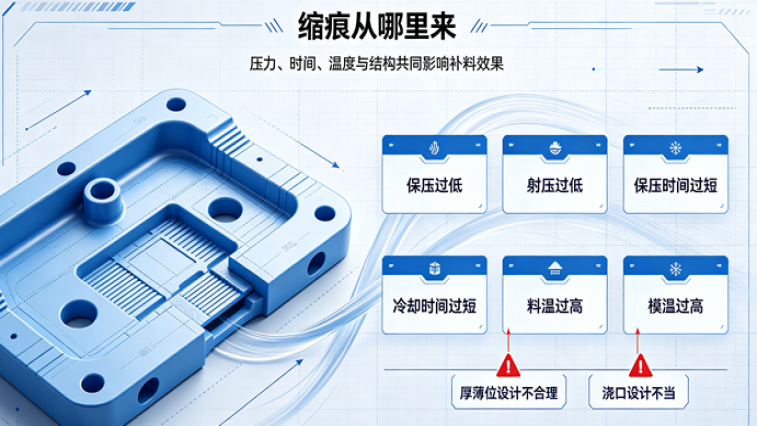
1. Molding Process Factors (priority on-site commissioning direction)
Insufficient holding pressure: cannot continuously feed melt to thick-wall ribs, resulting in inadequate compensation capacity;
Insufficient injection pressure: poor cavity filling compactness, leaving large reserved shrinkage space in rib areas;
Holding time too short: the gate freezes prematurely, cutting off the melt supply channel, and thick areas cannot receive continuous refill;
Insufficient cooling time: the product is demolded before fully setting, and continues to shrink after demolding, showing indentations;
Barrel temperature too high: the melt temperature is higher, increasing the plastic molding shrinkage rate;
Mold temperature too high: the melt cooling speed slows down, further amplifying the shrinkage difference between thick and thin areas.
2. Mold and Product Structure Inherent Factors
Unreasonable thick-thin design: the wall thickness difference between the roots of reinforcing ribs and blind holes and the outer wall of the product is too large, causing heat accumulation and forming heat traps; industry standard: rib thickness should not exceed 60% of the main body wall thickness;
Improper gate design: the gate cross-section is too small or the gate is too far from the defect area, causing large pressure transmission loss and making it difficult to refill the remote rib.
III. Tiered Improvement Countermeasures (First adjust the process; implement mold modification only when process adjustment is exhausted)
▶ Process Optimization (low-cost, quick implementation)
Moderately increase the holding pressure to strengthen the compensation effect on thick rib areas;
Reasonably raise the injection pressure to improve overall cavity filling compactness;
Extend the holding time to ensure continuous refill before the gate freezes;
Increase the cooling duration to ensure the product is fully cooled and set before demolding;
Lower the material temperature within the allowable material range to reduce the melt shrinkage rate;
Appropriately lower the mold temperature to accelerate surface solidification of the product and suppress surface indentations.
Commissioning priority reference: extend holding time → increase holding pressure → optimize mold temperature and material temperature
▶ Mold Structure Optimization (when process adjustment reaches its limit and still cannot improve)
Optimize the rib structure of the product, reduce the reinforcing rib thickness, and narrow the thick-thin gap; the thick-wall area can adopt a core-out (lightweighting) design;
Enlarge the gate cross-section and adjust the gate position to stay as close as possible to the sink-mark-prone area, reducing pressure loss;
Optimize the mold cooling circuit to improve heat dissipation conditions in the concentrated rib areas.
IV. Advantages of Ningbo Konger Machinery's Molding Solutions
Ningbo Konger Machinery Co., Ltd., rooted in the Ningbo injection molding machine industrial cluster and deeply engaged in the R&D and manufacturing of precision injection molding equipment, provides equipment + process integrated support for common mass-production defects such as sink marks at ribs and blind holes with its K-TEC Elf servo series and large logistics basket specialized injection molding machines:
Full closed-loop servo pressure control system supports multi-stage segmented holding pressure functions, dynamically adjusting pressure according to the different stages of melt filling and cooling, providing precise and continuous refill to thick-wall areas, effectively improving sink marks at reinforcing ribs and grid positions while eliminating indentations and avoiding internal stress and flash.
High-precision stable output of pressure and flow: fast pressure response and small pressure fluctuation, stably transmitting holding pressure even to remote gates, greatly reducing remote rib shrinkage caused by pressure decay, suitable for mass production of large basket and housing products with thick ribs.
Intelligent segmented temperature control system: independent multi-segment precise temperature control of the barrel supports refined material temperature adjustment; combined with a stable output curve, it makes it easy for process engineers to quickly adjust shrinkage-related parameters, shortening trial-molding adjustment cycles and reducing scrap.
Professional process technology empowerment service: Konger has a mature team of injection molding process engineers, providing supporting molding process support for customers in automotive parts, logistics packaging, daily necessities and home appliances. During pre-sales trial molding and after-sales mass production, it provides on-site process guidance for common defects such as sink marks, bubbles and warpage, delivering not just equipment but a complete molding solution.
Wide model coverage: full specification coverage of clamping force from 100T to 1400T, from small shells to large fruit baskets and logistics turnover boxes with dense reinforcing ribs, with matching models for every size, one-stop meeting the production needs of plastic products of different dimensions.
V. Summary
Sink mark control follows the principle of “process first, mold to solve the root cause”. At the production site, first quickly improve the situation by optimizing pressure, time and temperature parameters; when process adjustment reaches its limit, mold optimization must be carried out from product structure, gate and cooling circuit.
Choosing a precision injection molding machine with stable pressure control and multi-stage holding pressure support, combined with standardized commissioning thinking, can significantly reduce the defect rate of sink marks at ribs and blind holes, improve the yield rate and save raw material costs. If you are continuously troubled by sink mark defects in the production of turnover boxes, housings and grid products, please contact Ningbo Konger Machinery for a customized molding solution.
Ningbo Konger Machinery Co., Ltd. (Konger) focuses on the R&D and production of precision servo injection molding machines and specialized custom injection molding machines, providing global customers with stable, energy-saving, high-yield injection molding equipment and process technical support.