


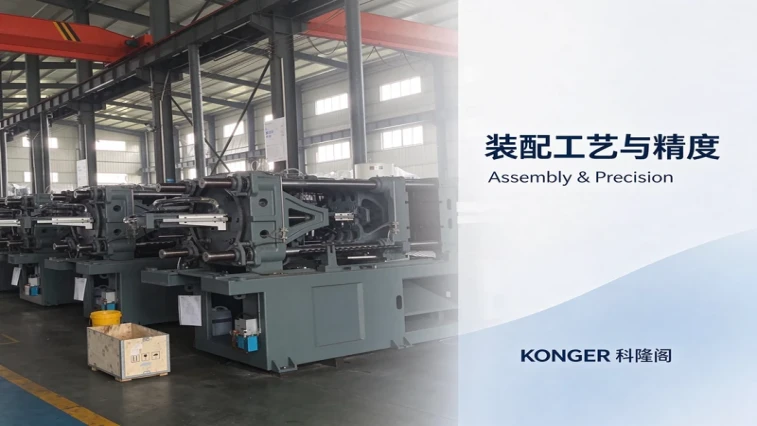
With the same set of parts, different assembly methods can produce machines that differ noticeably in accuracy and stability. A molding machine's precision is built up step by step on the assembly line; long-term stability depends on how stress, fit, cleanliness and fastening were handled during assembly. This article follows the assembly sequence and explains how each stage affects overall accuracy and stability.
1. How the assembly sequence sets machine accuracy
1.1 Base parts: casting stress relief and incoming inspection
Platens, toggle housings and tie bars are the machine's datum parts. If castings have not been properly stress-relieved, residual stress releases slowly in service, the platen deforms and parallelism drifts. Incoming inspection first checks casting appearance, machined faces and datum dimensions; if a base part fails, fine assembly later cannot make up for it.
1.2 Clamping unit: platen parallelism and tie-bar load
The relative position of the moving and fixed platens decides whether clamp force is spread evenly. Assembly keeps the plates parallel and the tie bars under even load; a parallelism bias pushes clamp force to one side, causing flash and one-sided wear at best, platen deformation at worst. Tie-bar and nut fit, together with load evenness, are the core of clamping-unit accuracy.
1.3 Toggle and guide columns: clearance and lubrication
The repeated end position of the toggle cycle depends on the clearance of pins, bushes and guide columns. Too much clearance drifts the open/close end position; too little, or poor lubrication, causes judder and noise. Clean fitting faces, controlled clearance and a clear lubrication path directly affect repeatability.
1.4 Injection unit: screw-barrel fit and alignment
The screw-to-barrel clearance and the alignment of the injection unit with the fixed platen decide how steadily the material is injected. Poor fit causes backflow and shot-weight variation; misalignment brings nozzle wear on one side, drooling and an unstable cushion. The assembly accuracy of the injection unit's guideway and locking structure shows up directly in part weight and dimension consistency.
2. How assembly craft affects long-term stability
2.1 Stress release and fastening sequence
Large fasteners are tightened in sequence and in passes, not all at once. The wrong sequence leaves residual stress; in service, bolts loosen and fitting faces shift, and accuracy decays. Torque, fastening order and re-checks exist to hold that stress down.
2.2 Cleanliness: hydraulics and piping
The hydraulic system is sensitive to cleanliness. Iron swarf, weld slag or dirt left in lines scores valve spools and blocks ports, leading to unstable pressure and valve faults. Line flushing, oil filtration and tank cleaning during assembly are the precondition for reliable hydraulic operation.
2.3 Electrical and signal wiring
The assembly quality of terminals, sensors and limit switches decides whether signals are reliable. Loose joints, loose terminals or unsecured wiring cause intermittent alarms under vibration. Tightened terminals, wire-number labels, fixed routing and screened grounding determine long-term control stability.
2.4 Fit tolerances and wear allowance
Component tolerances set the wear rate. Well-matched tolerances let clearance change slowly in service; tolerances that are too tight or too loose surface early as heat, wear or noise. Assembly must bring the fit relation inside the design tolerance range.
3. Inspection and trial run after final assembly
3.1 Levelling and static accuracy
After the machine is levelled in position, platen parallelism, tie-bar load and datum positions are measured first; the machine moves on to motion tuning only when static accuracy passes. Static inspection is the baseline for later dynamic accuracy.
3.2 Motion repeatability and pressure response
Dry-cycle open/close, injection-unit advance/retract and ejection are run repeatedly to observe whether the end position repeats, and whether pressure build-up and response are steady. Poor repeatability usually traces back to clamping-unit or injection-unit assembly.
3.3 Temperature rise and continuous running
During trial run, observe oil temperature, hydraulic components and fitting faces for heat, and re-check key accuracy after continuous running. Early assembly problems usually surface first in temperature rise and repeatability.
4. How Konger handles assembly and inspection
Ningbo Konger Machinery Co., Ltd. is based in Ningbo, founded in 2013, and covers the development, manufacture, sales and service of injection molding machines. The range is built around the K-TEC servo energy-saving series, with CMS (Color Mixing System) two-colour and sandwich machines, close to thirty customised dedicated models.
In machine building, several points line up directly with the assembly stages above:
Base parts first. K-TEC uses a split three-platen structure with thickened platens; the rigid base parts, together with parallelism and load control in assembly, give a steadier machine datum.
Clamping and injection built as units. The clamping unit secures platen parallelism and tie-bar load; the injection unit controls screw-barrel fit and alignment, reducing repeated on-site adjustment later.
Hydraulics and electrics checked with final assembly. Line cleanliness, pressure closed loop and signal wiring are verified during assembly rather than left for the customer's site team to sort out.
Parameters stored for traceability. Machine commissioning parameters and inspection results can be saved and recalled, so later mould or machine changes start from a recorded baseline.
5. Points to check during acceptance
Are platen parallelism and tie-bar load even?
Does the open/close end position repeat consistently?
Is the injection unit aligned with the platen, and nozzle wear normal?
Are hydraulic lines clean and pressure response steady?
Are key terminals and signal connections tightened and labelled?
After continuous trial run, is there abnormal heat or noise?
Does re-measured static accuracy hold up?
Are inspection records and parameters archived?
Conclusion
The assembly sequence is where accuracy comes from; assembly craft is what keeps stability. Base parts, clamping, injection, hydraulics/electrics and final inspection — any deviation in one stage is amplified onto the part. Konger's work on structural rigidity, unit-based assembly and factory inspection is about fixing accuracy at the assembly stage, before handing the machine over to run steadily in production.