


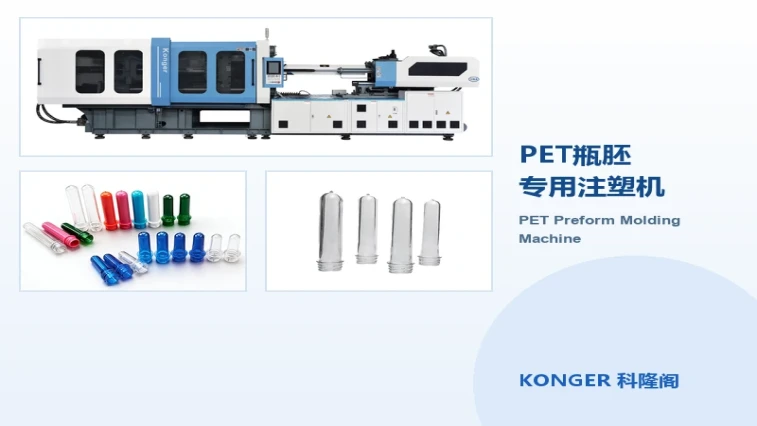
A PET preform is the moulded blank before blow moulding: even wall thickness, high clarity and controlled crystallisation, with processing conditions that differ from ordinary PP and PE parts. Selecting a PET dedicated machine has to follow preform specification, mould cavities, cycle time and target output — the experience from general-purpose machines does not carry over directly.
1. Four prerequisites before selection
1.1 Preform specification and material
Define preform weight, wall thickness, length-to-diameter ratio and material grade first. PET viscosity and drying condition change plasticising and injection conditions noticeably; without a clear specification, machine and screw configuration cannot be matched.
1.2 Mould cavities and layout
The number of cavities, gate form and hot-runner layout decide clamp force, shot weight and platen size. Cavity count is the middle variable connecting the part to the machine.
1.3 Target output and working shifts
Set the daily output requirement and shift arrangement first, then work backwards to the needed cavities and cycle. Different output targets call for different machine level and configuration.
1.4 Downstream support
Drying, feeding, take-out, stacking and the link to blow moulding must be considered at selection. If the machine and auxiliary interfaces do not match, high theoretical output never reaches delivery.
2. Key factors in selection
2.1 Clamp force
Calculate clamp force from the whole projected area of the multi-cavity mould and cavity pressure, with margin. Estimating from a single cavity invites flash on multi-cavity moulds.
2.2 Shot weight and screw
PET demands high plasticising quality; shot capacity must cover the total mould shot including runners. The screw geometry and barrel fit are configured for PET, not a general-purpose screw carried over.
2.3 Barrel temperature control and drying
PET must be dried thoroughly before moulding, and barrel zone temperature control has to stay stable. Fluctuating material temperature shows up directly in preform clarity and wall-thickness uniformity.
2.4 Injection speed and pressure response
Preforms have long flow paths and thin walls, needing steady high-speed fill and pressure response. A weak response affects end-of-flow fill and weld quality.
2.5 Clamp motion and ejection
Multi-cavity parts have to be picked out neatly and quickly; the clamp speed profile and ejection layout affect cycle and take-out stability.
2.6 Energy use and continuous running
Preform orders usually run long continuous shifts. Hydraulic energy, oil-temperature stability and component durability all get amortised into unit cost.
3. How output and cycle are evaluated
3.1 Cycle composition
One cycle splits into injection, hold pressure, cooling, clamp motion and take-out. Cooling usually takes the largest share; shortening the cycle starts with the cooling condition.
3.2 Output estimate
Output is estimated as cavities × shots per hour × effective working hours, then reduced for mould changes, trial setup and downtime. Theoretical cycle cannot be multiplied by theoretical working hours directly.
3.3 Cooling and mould-temperature effects
Mould temperature, cooling-water circuit and preform wall thickness together set cooling time; unstable cooling fluctuates both cycle and dimensions.
3.4 Look at continuous stability, not one-off cycle
A short trial cycle is easy to produce once. Real output is judged by yield, dimension repeatability and downtime after continuous running.
4. Common selection pitfalls
4.1 Applying general-machine experience to PET
A mismatch in screw, temperature control, drying and venting is the most common source of PET part problems.
4.2 Comparing tonnage only, ignoring shot weight and plasticising
Enough tonnage does not mean enough shot or stable plasticising; multi-cavity preforms especially need shot and plasticising margin.
4.3 Looking at trial cycle only, ignoring continuous stability
A short trial moulding cycle does not mean a steady production cycle; yield and downtime must be counted in.
4.4 Ignoring drying and hot-runner support
Under-dried material shows silver streaks and lower strength; uneven hot-runner temperature makes cavity-to-cavity quality inconsistent.
4.5 Cavity count not matched to the machine
Cavities pushed beyond machine capability, or insufficient machine margin, later block cavity expansion and output growth.
5. How Konger configures a PET dedicated machine
Ningbo Konger Machinery Co., Ltd. is based in Ningbo, founded in 2013, and covers the development, manufacture, sales and service of injection molding machines. The range is built around the K-TEC servo energy-saving series, with CMS (Color Mixing System) two-colour and sandwich machines, close to thirty customised dedicated models, among which PET preform is one dedicated configuration.
For PET preform production, the configuration idea includes:
Dedicated screw and barrel. Plasticising and shot capacity are matched to PET, supplying all cavities evenly.
Zone temperature control linked to drying. The barrel is controlled by zones, paired with drying and feeding conditions to keep material temperature and clarity steady.
Servo energy-saving hydraulics. Oil supplied on demand with a steady pressure response, suited to long continuous runs.
Multi-cavity mould fit. Platen, tie-bar spacing and ejection layout account for multi-cavity preform moulds, with room for take-out.
Parameters stored for traceability. Commissioning parameters and inspection results can be saved and recalled, giving a baseline after mould or batch changes.
6. Selection checklist
Are preform weight, wall thickness and material grade clear?
Are cavity count, gate and hot-runner form settled?
Was clamp force calculated from total projected area with margin?
Do shot weight and plasticising cover the total mould shot?
Are drying, feeding and take-out matched?
Is output estimated from cavities, cycle and effective hours?
Is continuous-running yield and downtime included in the evaluation?
Is the machine a PET dedicated configuration, not a general-purpose retrofit?
Conclusion
The core of PET preform selection is translating part specification, cavities, cycle and output into machine parameters, while avoiding pitfalls such as general-machine carryover, tonnage-only comparison and trial-cycle-only judgment. Konger's work on dedicated screw and barrel, zone temperature control and servo energy-saving hydraulics is built for products like PET that demand stable material temperature, clarity and continuous consistency.